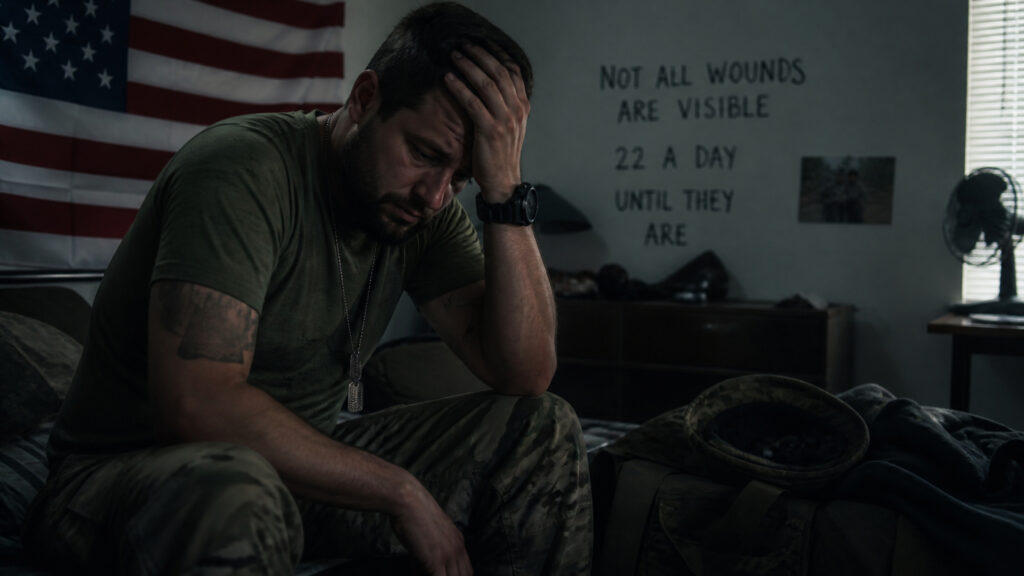
The short version: post-deployment stress usually fades within weeks to a couple of months, while PTSD is a diagnosable condition whose symptoms last more than one month and interfere with daily life. If nightmares, avoidance, numbness, or being on edge are still running your days a month after coming home, that is the line where a veteran should get checked. Here is how to tell the difference, and where the covered help is.
Coming home changes people. Feeling wired, wary, or short-tempered for a while is a normal readjustment reaction, not a disorder. The question is not whether you feel it, but how long it lasts and how much it costs you.
That distinction is not about toughness. It is a clinical line with a clear timeframe, and knowing it tells you when to wait it out and when to reach for care.
Key takeaways
- ✓Post-deployment stress is a common, normal reaction that usually eases within weeks to a few months.
- ✓PTSD is diagnosed when trauma symptoms last more than one month and impair work, home, or relationships.
- ✓PTSD can be delayed. In military groups, about 38 percent of cases show delayed onset.
- ✓Drinking to cope, nightmares, avoidance, numbness, and being constantly on edge are the red flags to get checked.
- ✓Both TRICARE and the VA cover PTSD screening and treatment, and you do not need a diagnosis to ask for help.

What is the difference between post-deployment stress and PTSD?
Post-traumatic stress, the everyday kind, is the body doing its job: the fight-or-flight response firing after danger. It is common, often adaptive, and it is not a mental illness.2 Combat and deployment stress reactions like irritability, poor sleep, low mood, and being keyed up are a normal response that usually eases after weeks or a few months at home.3
PTSD is a diagnosis. It requires exposure to a traumatic event plus a specific pattern of symptoms across four groups: intrusion (nightmares, flashbacks, unwanted memories), avoidance, negative shifts in mood and thinking (including emotional numbing), and heightened arousal (hypervigilance, startle, irritability, sleep and concentration problems). Crucially, the symptoms must last more than one month and cause real impairment.1
In the first few days to a month, heavy symptoms may point to acute stress disorder rather than PTSD. Past a month is the threshold where PTSD is evaluated.
| Timeframe after the event | What it may be |
|---|---|
| First few days | Normal acute stress reaction. Often eases on its own. |
| 3 days to 1 month | Heavy, impairing symptoms may be acute stress disorder. |
| More than 1 month | The threshold where PTSD is evaluated. Time to get screened. |
How long after deployment do symptoms usually start?
Often within weeks to months of the event. But PTSD does not always announce itself right away. Symptoms can appear weeks, months, or even years later.3
Delayed onset is more common in service members than civilians. A meta-analysis found delayed-onset PTSD in about 24.5 percent of all cases, but roughly 37.6 percent among military personnel and other high-exposure professionals.7 One practical takeaway: feeling fine at homecoming does not mean you are in the clear, and a delayed reaction is not a personal failing.
What are the warning signs that it is PTSD, not just stress?
The single biggest signal is time. If symptoms are still there after a month and they are shrinking your life, that is the moment to act. Specific red flags include:
Nightmares or flashbacks, avoiding people, places, or reminders, emotional numbness or feeling detached from family, hypervigilance and an exaggerated startle, ongoing irritability or anger, sleep and concentration problems, and clear impairment at work or home. Using alcohol to cope or to sleep belongs on this list too, and any thoughts of suicide mean reaching out right now.
Self-medicating is common rather than rare. More than 4 in 10 adults with PTSD also have a drug or alcohol problem, and veterans with PTSD are about twice as likely to develop alcohol problems.5 Because trauma and substance use feed each other, PTSD and substance use are best treated together.
Can PTSD show up months or years later?
Yes. Delayed-onset PTSD is real, and it is more common in veterans. The nuance worth keeping honest is that a delayed diagnosis usually follows earlier, lower-level symptoms rather than appearing from nothing after years of feeling fine.7
For veterans, that means a homecoming that felt manageable can still give way to PTSD later, especially under new stress. It is a reason to keep an eye on the red flags long after the deployment ends, not just in the first months back.
How do veterans get screened for PTSD?
Screening is quick and low-stakes. In primary care it often starts with a short five-item screen; a positive result leads to a fuller assessment, frequently the PCL-5, a 20-item checklist that maps to the diagnostic symptoms and helps track progress over time.6
Evidence-based treatments that work well for veterans include Cognitive Processing Therapy, Prolonged Exposure, and EMDR, often alongside medication.1 None of this requires you to have a diagnosis before you ask. If pills have not been enough, newer options exist too, including TRICARE-covered treatments like Spravato and TMS for related depression.
Does TRICARE or the VA cover PTSD treatment?
Both do. TRICARE lists PTSD among covered mental-health conditions and covers therapy and medication, and the VA delivers PTSD screening and evidence-based care through its system.8 Coverage for the talk-therapy side is spelled out in how TRICARE covers therapy and counseling.
The practical point for a veteran or family member: cost and coverage are rarely the real barrier here. The barrier is knowing when what you are feeling has crossed from readjustment into something that deserves care.
Our take
Watch the clock, then watch the cost
The cleanest test is the calendar. A rough few weeks after deployment is expected. Symptoms that own your days a month later, or that push you toward a drink to get through the night, are not something to tough out. That is information, not weakness.
Recoverion is independent and does not provide treatment or earn anything from referrals. We point this out plainly because a lot of veterans wait years, telling themselves it is just stress, while the covered help was there the whole time. Get screened early, and let the coverage sort itself out after.
Find out where your PTSD care is covered
A short check can show you what your plan covers before you take the next step.
- Check what your plan covers with the coverage checker.
- See how PTSD and substance use are treated together for veterans.
- Start at the Recoverion home page to find what fits your situation.
If you or a loved one is in crisis or thinking about self-harm, call the Veterans Crisis Line now: dial 988, then press 1. It is free, confidential, and open to family members too. For a medical emergency, call 911.
Questions veterans ask
How do I know if I have PTSD or if I am just stressed?
Normal stress fades within days to a few weeks. PTSD means trauma symptoms like nightmares, avoidance, numbness, or being on edge that last more than a month and interfere with daily life.1
Is it normal to feel on edge after deployment?
Short-term hypervigilance is a normal readjustment reaction. It becomes a red flag when it lasts past about a month or starts damaging your work and relationships.
How long after deployment does PTSD start?
Often within weeks to months, but it can be delayed by six months or more. Delayed onset shows up in roughly 38 percent of military cases.7
What is the difference between PTSD and adjustment or readjustment?
Readjustment stress is time-limited and tied to the transition home. PTSD requires trauma exposure plus the symptom clusters lasting more than one month.
I came back angry and irritable. Is that PTSD?
Irritability is one arousal symptom, not a diagnosis on its own. Combined with intrusion, avoidance, or numbing lasting more than a month, it is worth a screen.
I keep having nightmares and cannot sleep. Should I get checked?
Yes. Nightmares and sleep disturbance are core PTSD symptoms. If they persist past a month, a short PTSD screen is a reasonable next step.
Is drinking to fall asleep a sign of a bigger problem?
It can be. Self-medicating is common, and more than 4 in 10 people with PTSD have a substance problem, usually with PTSD coming first.5
Do I need a PTSD diagnosis to get help from the VA or TRICARE?
No. Both cover mental-health care, and you can seek help before or without a formal diagnosis.8
What happens when you get screened for PTSD?
Usually a short five-question screen in primary care, and a positive result leads to a fuller assessment, often the 20-item PCL-5 plus a clinician interview.6
Can PTSD appear years later even if I felt fine at first?
Yes, delayed onset is real and more common in veterans, though it usually follows earlier low-level symptoms rather than appearing from nothing.7
Sources
- VA National Center for PTSD, DSM-5 Criteria for PTSD.
- BrainLine, Differences Between PTS and PTSD.
- Military OneSource, Understanding Combat Stress and PTSD.
- VA National Center for PTSD, How Common Is PTSD in Veterans.
- VA National Center for PTSD, PTSD and Substance Use.
- VA National Center for PTSD, PCL-5.
- Smid et al., Delayed Onset PTSD meta-analysis.
- TRICARE, Mental Health Care.
- VA, 2024 National Veteran Suicide Prevention Annual Report.
Recoverion is an independent educational resource, not a treatment provider, insurer, or government agency. This article is general information, not medical advice, and it does not replace a clinical evaluation. If you are concerned about PTSD, talk with a licensed provider, the VA, or your TRICARE plan.